Understanding Executive
Function
Your brain's leadership operating system—the cognitive foundation that determines whether you thrive or freeze under pressure.
Executive Function &
Leadership Performance
Most leadership breakdowns don’t happen because of poor intent, lack of experience, or weak skills. They happen because Executive Function degrades under pressure. This is not a personality issue. It’s a performance system under load.
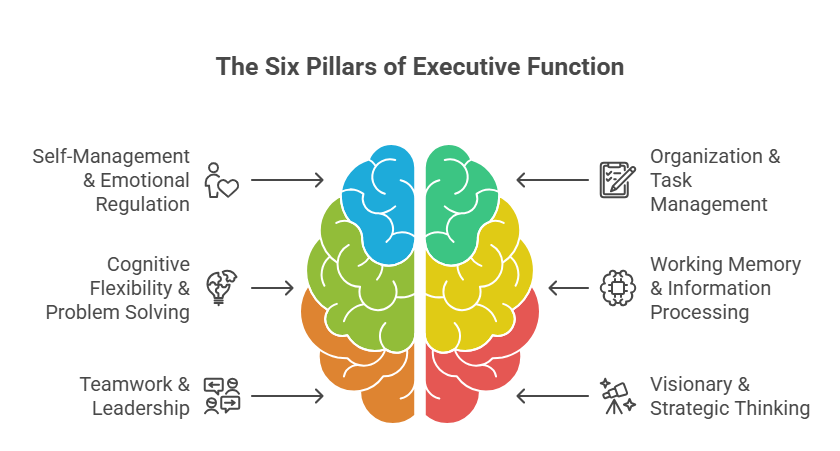
Self-Management & Emotional Regulation
This function governs stress tolerance, emotional modulation, and impulse control. Under pressure, degradation in emotional regulation increases the likelihood of reactive decision-making, conflict escalation, and judgment errors. Empirically, failures in leadership frequently originate from emotional dysregulation rather than from deficits in knowledge or intent. When this dips, you react quickly and have trouble staying steady under stress.
Organization & Task Management
This domain encompasses prioritization, sequencing, and execution. Leaders with reduced capacity here exhibit chronic urgency, fragmented focus, and tactical overreach. Effective leadership is not defined by volume of activity, but by accurate prioritization under load. When this is low, priorities blur and tasks feel harder to manage.
Cognitive Flexibility & Problem Solving
Cognitive flexibility enables leaders to shift perspectives, revise mental models, and abandon ineffective strategies. Under stress, reduced flexibility results in perseveration—continued commitment to failing approaches despite contradictory evidence. When this is strained, change feels disruptive and problem solving slows down.
Working Memory & Information Processing
Working memory supports the integration of multiple information streams in real time. Leadership decisions often require holding competing variables simultaneously. When this capacity is compromised, leaders oversimplify complex problems or experience decision paralysis. When this is overloaded, details slip and information is hard to hold onto.
Teamwork & Leadership
This function supports clear communication, delegation, and coordination. Under stress, impaired social executive functioning increases ambiguity, role confusion, and dependency within teams. Teams do not require more directives under pressure; they require clarity rooted in cognitive stability. When this is stretched, communication misfires and collaboration takes more effort.
Visionary & Strategic Thinking
Strategic Executive Function enables leaders to maintain long-term orientation while managing short-term demands. When compromised, leaders become tactically reactive, sacrificing future outcomes for immediate relief. When this is low, it is harder to see the big picture or create a clear direction.
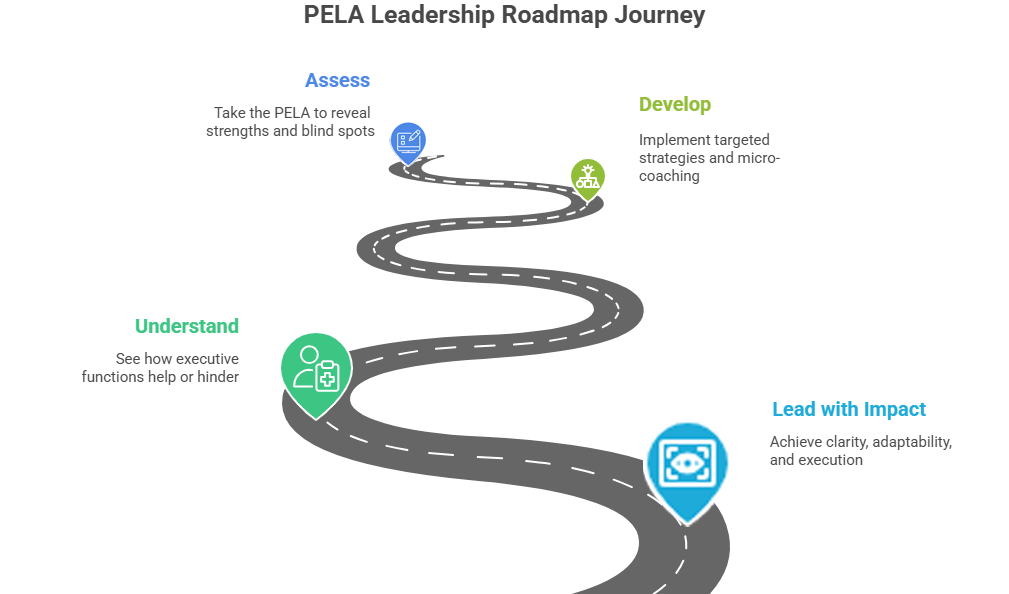
If any of these feel familiar, your executive function skills are carrying more weight than they should. The Precision Executive Leadership Assessment (PELA) shows you exactly where the strain is coming from and how to improve it.
Executive Function (EF) is the brain’s management system
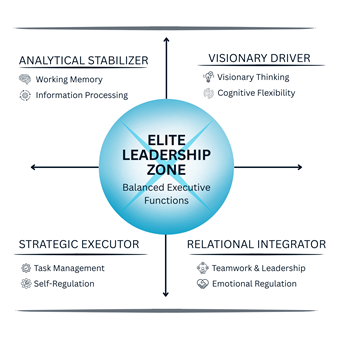
It’s how you decide, regulate, prioritize, adapt, and lead—especially when pressure is high, information is incomplete, and emotions are loud.
The Six Domains
Self-Management & Emotional Regulation
Turn strategic intent into structured action with clear priorities.
Organization & Task Management
Adapt fast when plans fail, markets shift, or obstacles emerge.
Cognitive Flexibility & Problem Solving
Hold, process, and synthesize complex information in real-time.
Working Memory & Information Processing
Maintain composure and clarity in high-pressure moments.
Teamwork & Leadership
Make deliberate, strategic decisions under pressure.
Visionary & Strategic Thinking
Sustain deep concentration and filter distractions.